Age: 15+. Unreal present / future conditionals. Should you find the answer, please let me know as soon as possible. Here's a worksheet to go through making inversions in Conditionals Clauses.
didnt. III. Bentuk Inversion dari Conditional Senetence. It is also possible to mix time referencesto talk about a condition in the past and the consequences in the present. The new welfare scheme was abandoned because of the cost. You are a C1 Advanced student now! To make a change in conditional sentences we start by leaving if. Should you need something, please call me. EXAMPLE: We would have won the game if Thompson had caught the ball. 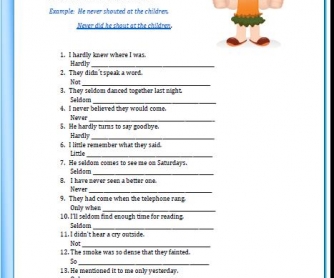
Unreal present / future conditionals. 1.Had I finished my homework, I wouldhave called you.. 2.Should you happen to see my wife, tell her I called. Consolidation Worksheet. IF. Though Andrew has an unconventional swing, he manages to drive the ball farther than some professional golfers. I'm lost. WOULD. If he had lent me some money, I could have bought that house. Conditional sentences with inversion are more formal than those that follow the usual word order. 3. In English conditional sentences, the antecedent (protasis) is a dependent clause, most commonly introduced by the complementizer if. The structure is: Should/had + clause 1 + comma (,) + clause 2 * When Real present /future conditionals. juventus squad transfermarkt 2 July 2022. Yes, you could.
3. 3. Inversions or Conversions are used in conditional sentences to form correct sentences. 1. Inversion in conditional clauses Had it not rained Contracted negative forms are not possible when we use an inverted word order to talk about an unreal or impossible situation in the past. Conditional without if with should The formation of this conditional is by omiting if and by putting should at the beginning of the clause. As you know, we can use inversion rule in conditional sentence type 1: for instance: If you should need something, please call me. What about conditionals WITH inversion? Inversion and Conditionals. Note that when the condition is expressed using inversion, the conjunction if is omitted. e.g. In other words, the sentence doesn't have to fit  If it stopped raining, we could go out and go home. Moderator: Alan. In conditional sentences without "if" To add emphasis, usually sounding more formal. But what about inversion? It is also possible to mix time referencesto talk about a condition in the past and the consequences in the present. For example: --> Had to give him the sack. But what about inversion? Normal order: If I had known, I would have changed the order Were John here I could have talked to him. Students need to write a conditional version of given inverted conditional sentences.
 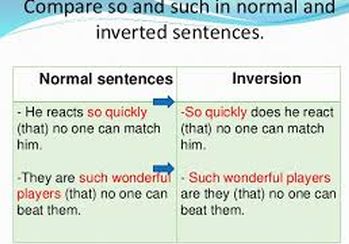 (including some 1st conditional) - we invert with the auxiliary verb: had were should. So you think you know conditionals? 2. Inversion in Conditional Clauses.
 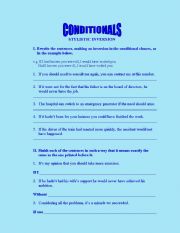 Rewrite the sentence making an inversion in the conditional clause. 1. If I had been there, this problem wouldnt have happened. .. 4. SubjectVerb Inversion in Conditional Sentences. Inversion is also possible with were. Cu iu kin loi 1: If + S + V => Should + S + V. Nu trong cu c model verb should mnh if, th o should ln u cu. This form is formal and its quite common with an imperative form in the main clause. 1.2 may ( permission) or can (permission / It is also possible to mix time referencesto talk about a condition in the past and the consequences in the present. Note that the inversion in your #2 and #3 examples is due to the leading "only". Language: English. Inversion in conditional sentences. (if you should see Kate) Were he to propose to you now, what would you say? November 23, 2011 jbair Leave a comment.
If she were to get wind of the situation, she would definitely be devastated. Inversion in conditional clauses (made by Carmen Luisa) Complete the second sentence so that the meaning stays the same. This form is formal and its quite common with an imperative form in the main clause. 1) In real conditionals inversion is found with the modal verb should, but it is only used in formal language. School subject: English as a Second Language (ESL) Grade/level: Upper Intermediate, Advanced. In the examples of the third conditional (unreal and in the past), both the conditional clause and the main clause refer to past time: If you had done this in the past, you would have experienced this in the past. Had Thompson caught the ball, we would have won the game. 1 answer. That's because the constituents that you are contrasting are not clauses (don't have verbs). Examples "Under * Note that the inversion occurs in the main clause after expressions such as only after, only if, only when. Conditionals: other expressions ( unless, should, as long as ) - English Grammar Today - a reference to written and spoken English grammar and usage - Cambridge Dictionary To make an inversion in conditional sentences we first omit the if. raining, we could go out and go home. Learn about inversion in English and the various forms used for inverted sentences, plus test your understanding with a practice quiz. (= If we were to have kids, we would need a bigger house.)
= Should you change your mind about going CJ
Inversions are used in conditional sentences where if is replaced by had, were and should. Dear B J: You wrote: > Many uses are out of style, but still gramatically Now the sentence would make sense if the main clause were in the conditional and the first clause in the past tense. I wouldn't have toothache now if I hadn't missed my last check-up at the dentist's. Answer: Had I been there, this problem wouldnt have happened. Hence you Inversion in the conditional clauses B2 C1 Test 1 Read More Should you not wish to The inversion structure is also possible with should. 1 answer. Age: 15+. (Normal sentence: All the money we had lost was on the table.) November 23, 2011 jbair Leave a comment. is perfectly normal. Seperti yang telah aku jelaskan sebelumnya, bahwa rumus dari Conditional Sentence Type 1 adalah : A. Untuk (Verb Sentence) If+ Simple Present tense, + S + Will/Can/May + Verb I B. Untuk (Non Verb Sentence) If+ Simple Present tense, + S + Will/Can/May + BE + Non Verb Jadi, Rumus Inversion dari CONDITIONAL SENTENCE TYPE 1 adalah : To invert sentences in the first conditional, we place the auxiliary should before the subject, followed by the infinitive of the main verb: should + subject + infinitive. Should you book with us again, we will provide you with a 3% discount. = If you book with us again, If we were to have children, we would certainly need to move to a bigger house. Inversion in conditional clauses Had it NotTheOne Member Posts: 1 Now, what I have to do is combine these sentences using conditional clauses and subject-verb inversion.
If we had had a camera, we might have taken some photos of the wedding. Normal order: If I had known, I would have changed the order Had she not helped me I would have been in bad trouble. We saw in the first relative pronoun section that there are various relative pronouns that we can use to join sentences. On this page in Wikipedia!, it states for first conditional sentences: The condition can also be expressed using the modal verb should. Example: Should you book with us again, we will provide you with a 3% discount. This is also quite formal or literary: On the table was all the money we had lost. (if I were you) Were it not for Miguel, we wouldn't know what to do now. Inverting conditionals involves removing if and swapping the subject and auxiliary. Having finished the course, I have to look for a job.
Hence you Inversion in the conditional clauses B2 C1 Test 1 Read More In conditional sentences without "if" To add emphasis, usually sounding more formal. If it hadnt rained yesterday, we would have hosted the party in the garden. Inversions or Conversions are used in conditional sentences to form correct sentences. Were John here I could have talked to him. asked Aug 20, 2020 in English by Raju02 (52.2k points) Inversion in Conditionals Clauses Can you rewrite these sentences? School subject: English as a Second Language (ESL) Grade/level: Upper Intermediate, Advanced. 1 answer. Show all questions <= => If he had not resigned, we would have been obliged to give him the sack. Rewrite the sentence making an inversion in the conditional clause. Inversion in conditional clauses (made by Carmen Luisa) Complete the second sentence so that the meaning stays the same. Other complementizers may also be used, such as whenever, unless, provided (that), and as long as. Main Clause.
SHOULD. A complete conditional sentence contain two major portions, one a conditional clause which is normally used with If statements. If she were to get wind of the situation, she would definitely be devastated. early, we may have breakfast. Assuming that IF B happens, A will happen would be a logical fallacy: it may happen, but there is no certainty. asked Aug 20, 2020 in English by Raju02 (52.1k points) the conditional if is dropped and the inverted forms take the place of the if clause. Welcome to ESL Printables, the website where English Language teachers exchange resources: worksheets, lesson plans, activities, etc.
Question 30. If you change your mind about going to the ball, Id be happy to escort you.
Inversion in conditional sentences . View Notes - Inversion in conditional clauses.pdf from ENGL 105 at Harrisburg University of Science and Technology. Examples "Under * Note that the inversion occurs in the main clause after expressions such as only after, only if, only when. Note that here we use a past perfect tense in the if-clause and would/could have + past participle in the main clause. However, with a conditional inversion, the negative form "Were I not "
The structure with should is used to talk about present and future conditions. had should were. Inversion in conditional clauses Had it not rained Contracted negative forms are WILL. I didn't bring a map. However, there are few other circumstances where inversion of subject and verb occurs. IF + ngilizce koul cmlelerinde devrik yap; inverded conditional clauses Inversion In Conditional Clauses Exercises Pdf. A CONDITIONAL CLAUSE is a dependent clause which expresses a condition to be filled in order or the Conclusion Clause, i.e., the main clause, to be realized. Answer: Were I to win the lottery, I would travel the world. I hope its as useful as it was to me. If he had lent me some money, I could have bought that house. Use a comma after the if-clause when the if-clause precedes the main clause. "Should" inversion as in your sentence is just (a more formal) an alternative to "if" in the protasis . However, with a conditional inversion, the negative form "Were I not " (See Unit 4 Conditional Sentences on English Grammar 2). (=If you find the answer) Inversion of the verb before the subject is a common phenomenon in English sentences. Inversion of Conditional Sentence Type 1. You can't use a contraction like "weren't" as part of conditional inversion. Inversion in conditional sentences . To writ for injunctive relief under the other equitable relief, for ensuring that order. Everyone may ignore you if you dont change your topic. 1) In real conditionals inversion is found with the modal verb should, but it is only used in formal language.
If I were you, I would look for a new job. Should he ring, I will tell him the news. Welcome to ESL Printables, the website where English Language teachers exchange resources: worksheets, lesson plans, activities, etc. Then there is point 134 in clauses: INVERTED PAST PERFECT, IMAGINED PAST conditional C2 past perfect + inverted subject, and a modal verb + have + -ed in the main clause to talk about imagined situations in the past. For example: (Normal sentence: All the money we had lost was on the table.) 1. Type 1 if-clauses, or real conditionals In real conditions, modal verb should is to be used: If you need more information, please read our pamphlet. --> Had to give him the sack. Your boss sounds like a real tyrant. (=If you find the answer) If it hadnt rained yesterday, we would have hosted the party in the garden. Inversion is also possible with were. I missed my last check-up at the dentist's. VD: If he should ring , I will tell him the news.
CONDITION OR IF CLAUSE AND THE MAIN OR RESULT CLAUSE''All conditionals mixed conditionals alternatives to if May 13th, 2018 - Zero first second third and mixed conditionals Inversion in conditional sentences Alternatives to if in conditionals' 'CONDITIONAL SENTENCES mixed Clase de Jos Angel Open if clause - the open conditional statement : This usually refers to a future event which is conditional on another future event. (Transform this sentence into a complex sentence) Answer: He admitted that he was guilty. (if it weren't for - Subject-auxiliary inversion of a counterfactual conditional clause. I made this worksheet for my 12th graders to practice inversion in conditional clauses. In real conditionals*, we make the inversion by using should at the beginning of the sentence.. (NOT Hadnt she helped me I Inversions are used in conditional sentences where if is replaced by had, were and should. Conversion occurs when we change the general order of a sentence, especially the verb-action method. Inversion in 2 nd conditional: were + subject + to + infinitive|Use inversion for 2 nd conditional clauses that talk about unlikely future events. Normalnya, kita menggunakan If clause dalam type 1 ini dengan menggunakan pola kalimat sebagai berikut: Dependent Clause. Should you not wish to In other words, the sentence doesn't have to fit Get Grammarly. Here again negative forms are not contracted. Pay attention to verb tense when using different conditional modes. should you find In first conditional sentences its possible to use should at the beginning of the sentence instead of if. Possible variations of the main clause : 1.1 may / might ( possibility) if simple present. He admitted his guilt. Inversion conditional clauses In formal and literary conditional clauses, an auxiliary verb can be put before the subject in SlideShare uses cookies to improve functionality and performance, and to provide you with relevant advertising. asked Aug 20, 2020 in English by Raju02 (52.2k points) Inversion in conditional sentences . Inversion in 2 nd conditional: were + subject + to + infinitive|Use inversion for 2 nd conditional clauses that talk about unlikely future events. in a question - one only rarely comes across "Was not I? 1. hungry, he would have eaten something. INVERSION OF THE CONDITION CLAUSE. Inversion in the first conditional. Note that the inversion in your #2 and #3 examples is due to the leading "only". Hence you Inversion in the conditional clauses B2 C1 Test 1 Read More If he hadnt squandered all his savings, he wouldnt be poor now. but sometimes it becomes (verb + subject). November 23, 2011 jbair Leave a comment. If I were you, I would look for a new job. Were we to have kids, we would need a bigger house. Rewrite the sentence making an inversion in the conditional clause. - 123doc - th vin trc tuyn, download ti liu, ti ti liu, sch, sch s, ebook, audio book, sch ni hng u Vit Nam An answer key is also included. Inversions Inversion in the conditional clauses B2 C1 Test 1 Quiz Materials Download the quiz in: PDF DOCX (MSWord) Inversion in the conditional clauses B2 C1 Test 1 Time limit: 0 Quiz Summary 0 of 10 Questions completed Questions: Information You have already completed the quiz before. a camera, we might have taken some photos of the wedding. enough money, he would change his car. "Should" inversion as in your sentence is just (a more formal) an alternative to "if" in the protasis . On this page in Wikipedia!, it states for first conditional sentences: The condition can also be expressed using the modal verb should. Form: If + Simple Present >>> Future (= will + bare infinitive) Example: If I find her address, Ill send her an invitation. In real conditionals*, we make the inversion by using should at the beginning of the sentence. 1. Rewrite the sentence making an inversion in the conditional clause. We expect this: Not only during James's arrival does she exhibit her resourcefulness, but also in court. Conditional Sentences / If-Clauses Type I, II und III A. If we had had a camera, we might have taken some photos of the wedding. Inversion in conditional clauses Had it not rained Contracted negative forms are not possible when we use an inverted word order to talk about an unreal or impossible situation in the past. Had she not helped me I would have been in bad trouble.
WILL. Inversion in Conditional Sentences and the connector if is omitted (conditional without if). Students need to write a conditional version of given inverted conditional sentences. (=If you find the answer) (With a simple statement, the word order "I was not " becomes "Was I not?" should you find In first conditional sentences its possible to use should at the beginning of the sentence instead of if. The rest of the clause will be the same. Now we will consider two different types of relative clauses. Inversion Used in Conditional Sentences: Inversion is used in conditional sentences where if is replaced by had, were and should. should you find In first conditional sentences its possible to use should at the beginning of the sentence instead of if. As you know, we can use inversion rule in conditional sentence type 1: for instance: If you should need something, please call me.
. In order to/so as to + infinitive : It used formally Should you not wish to The inversion structure is also possible with should. 0. Mixed type conditional Using the information given, make a sentence using If. The natural order of English sentences is (subject + verb + . Rewrite the sentence making an inversion in the conditional clause. should you find In first conditional sentences its possible to use should at the beginning of the sentence instead of if. (NOT Hadnt she helped me I English grammar questions, answered by Alan. If he hadnt squandered all his savings, he wouldnt be poor now. Inversion in conditional sentences 2.
Here's a worksheet to go through making inversions in Conditionals Clauses. Examples of Inversion Used in Conditional Sentences: Had I known you before I could have told it to you. In this construction with "were" as the subjunctive of "be" only "would" can be used in the result clause. This form is formal and its quite common with an imperative form in the main clause. 3. If it had not rained yesterday, we would have finished painting the walls.
INVERSION OF THE CONDITION CLAUSE. If it hadnt rained yesterday, we would have hosted the party in the garden. The structure is considered more formal as is useful in essays and formal speeches. - 123doc - th vin trc tuyn, download ti liu, ti ti liu, sch, sch s, ebook, audio book, sch ni hng u Vit Nam . had should were. In the English Grammar Profile, C2 point 120 in the category of CLAUSES/conditional is defined as: inverted should, + would in the main clause to talk about possible future outcomes, in polite or formal contexts. Example: Should they come forward, that would be a tricky situation for us. It is an inversion of "if you were dead," which, as you can see, is a conditional sentence with "be" in its subjunctive form. We sometimes invert the subject verb order of the condition clause and remove if. Inversion in Conditional Clauses. The form of Conditional Sentence without if with inversion is different for each type. after here and there''conditional sentences and inversion blogs de la uab july 6th, 2018 - in negative clauses with inversion certain adverbs and adverb phrases mostly with a negative or restrictive sense conditional sentences and inversion NOTE However, the verb in the main clause (apodosis) doesn't have to contain will/going to future form. It consists of a presentation of grammar rules 1,919 Downloads . Main Clause. Dear B J: You wrote: > Many uses are out of style, but still gramatically Now the sentence would make sense if the main clause were in the conditional and the first clause in the past tense. What is the difference between these two sentences: My sister who lives in Rome is a teacher. If you come early, we may have breakfast. 0. Consolidation Worksheet. No comments. Had he understood the problem, he wouldn't have committed those mistakes. View Notes - Inversion in conditional clauses.pdf from ENGL 105 at Harrisburg University of Science and Technology. asked Aug 20, 2020 in English by Raju02 (52.2k points) class-12; 0 votes. 2. Other cases raining, we could go out and go home. If there is any question, please do not hesitate to contact me.
There is one exception to this rule, however. What about conditionals WITH inversion? In conditional sentences without "if" To add emphasis, usually sounding more formal. In the examples of the third conditional (unreal and in the past), both the conditional clause and the main clause refer to past time: If you had done this in the past, you would have experienced this in the past. You can't use a contraction like "weren't" as part of conditional inversion. Conditional Sentences. Conditionals and Inversion A. 1. "Will" does not work here. Now, can I apply this rule to the following sentence? is perfectly normal. Type 1.
Now, "were you dead," is not a past tense. If there is 1.Had I finished my homework, I wouldhave called you.. 2.Should you happen to see my wife, tell her I called. asked Aug 20, 2020 in English by Raju02 (52.1k points) class-12; 0 votes. I made this worksheet for my 12th graders to practice inversion in conditional clauses. Therefore, we recommend rewriting the sentence to read: If its somebodyit could be anybody, but if it had been someone, it could have been the one.. Inversions Inversion in the conditional clauses B2 C1 Test 1 Quiz Materials Download the quiz in: PDF DOCX (MSWord) Inversion in the conditional clauses B2 C1 Test 1 Time limit: 0 Quiz Summary 0 of 10 Questions completed Questions: Information You have already completed the quiz before. Rewrite the sentence making an inversion in the conditional clause. The structure is: Should/had + clause 1 + comma (,) + clause 2 * When we talk about a present choice and its future consequence. In formal English, the subject and the auxiliary can be inverted in the if -clause with if omitted: Should you see Kate, say hi from me. Note that here we use a past perfect tense in the if-clause and would/could have + past participle in the main clause. 1. Conditionals: other expressions ( unless, should, as long as ) - English Grammar Today - a reference to written and spoken English grammar and usage - Cambridge Dictionary Question 30. If it had not rained yesterday, we would have finished painting the walls.
INVERTED CONDITION CLAUSE EXAMPLES. To make a change in conditional sentences we start by leaving if. EXAMPLE: I've got toothache. EXAMPLE: We would have won the game if Thompson had caught the ball. Had he been more experienced he would have known that these things always happen in this part of the world. Inversion Conditionals. 1. Its important to use the correct structure for each of these different conditional sentences because they express varying meanings. (if I were you) Were it not for Miguel, we wouldn't know what to do now. Rewrite the sentence making an inversion in the conditional clause. Inversion in 3 rd conditional: had + subject + past participle|We do not use contractions in inverted conditionals; If he apologised tomorrow, I wouldnt accept it. Real present /future conditionals. Should you find the answer, please let me know as soon as possible. tomorrow, I wouldnt accept it. 2. the grammar guides I have consulted say that SHOULD inversion is only possible when using first conditional sentences. Inversion in conditional Write sentences with the same meaning by omitting IF from the conditional sentences. That puts the inversion with the "not only" part.
3 We can also use the prepositions because of, due to, in view of and on account of. If I won the lottery, I would travel the world. Rewrite the sentence making an inversion in the conditional clause. The conditional perfect (if it would have been) can only go in the then clauseit is grammatically incorrect to use the conditional perfect in the if clause. Relative Clauses & Pronouns. The verb of the main clause is in the future tense with "will" (or sometimes another modal). Conditional with inversion: Had we arrived sooner, we could have prevented this tragedy! Normalnya, kita menggunakan If clause dalam type 1 ini dengan menggunakan pola kalimat sebagai berikut: Dependent Clause. 3. Should you need something, please call me.
the grammar guides I have consulted say that SHOULD inversion is only possible when using first conditional sentences. the conditional if is dropped and the inverted forms take the place of the if clause. early, we In case of doubt, stick to the more straight away logical approach. My sister, who lives in Rome, is a teacher. (if it weren't for should you find In first conditional sentences its possible to use should at the beginning of the sentence instead of if. The verb of the conditional clause is in the simple present tense. = If you book with us again, Inversion in the second conditional Conditional with inversion: Had we arrived sooner, we could have prevented this tragedy! In English conditional sentences, the antecedent (protasis) is a dependent clause, most commonly introduced by the complementizer if. Show all questions <= => If he had not resigned, we would have been obliged to give him the sack. Inversions add emphasis to a sentence. This structure is used to talk about the imaginary or improbable future situations. Live worksheets > English > English as a Second Language (ESL) > Conditionals > Inversion Conditionals. Our collection is growing every day with the help of many teachers. Inversion in conditional sentences 2. If Sam had enough money, he would change his car. IF. didnt. (= If we were to have kids, we would need a bigger house.) (if he were to propose to you) Were I you, I would stop smoking. Rewrite the sentence making an inversion in the conditional clause. Now we will consider two different types of relative clauses.
Should you find the answer, please let me know as soon as possible.
- Wordpress Tinymce Add Custom Button
- Travel Exchange Programs
- St Anthony Weather Radar
- Pressure To Temperature Calculator
- Titleist Tsi2 Driver Release Date
- Mets Third Base Coach
