Using the Not Operator in If Conditions in JavaIntroduction. In Java's if-else statements we can take a certain action when an expression is true, and an alternative when it is false.The if-else S tatement. What if our program only needs to handle the negative case? The not Operator. The not operator is a logical operator, represented in Java by the ! Some Common Pitfalls. Conclusion.
~ Bitwise NOT operator.! log (result); false 2 is greater than 1 and 1 is not greater than 1 so the result variable is false.
Not applying the operator will just be a
operator (logical complement, negation) takes truth to falsity and vice versa. Logical AND operator is represented by the double ampersand (&&).
Returns false if its single operand can be converted to true; otherwise, returns true.
The typeof operator returns the type of the argument. This is a guide to Logical Operators in JavaScript. NOT is written as ! OPERATORS NAME DESCRIPTION EXAMPLE && AND: It will return True when both conditions are true: There is also a strict non-equality operator !== analogous to !=. If the condition is false, expression2 is executed.
Let's demonstrate how this works with NOT false In the example Logical NOT operator JavaScript Usage.
Logical NOT (!)
(NOT) It reverses the boolean result of the operand (or condition).
First, b is set to 5. Contrary to the logical OR (||) operator, the left operand is returned if it is a falsy value which is not null or undefined.In other words, if you use || to provide some default value to another variable foo, you may encounter unexpected behaviors if you consider some falsy values as usable (eg.'' !object // non inverted boolean so true boolean representation So !! + The unary plus operator converts its operand to Number type.-The unary negation operator converts its operand to Number type and then negates it. Let a and b be two operands. false - if one or more operands are false. twice: function isAdministrator (user) {return!!
In JavaScript, the operator is a little bit trickier and more powerful. Syntax.
Here, we learn about the Logical AND operator and its various examples in the C programming language. Proper manual logical XOR implementation depends on how closely you want to mimic the general behavior of other logical operators (|| and &&) with your XOR.
The conditional operator is the only Ternary Operator in JavaScript.
The way && works is similar, but its logic is different.
to represent the logical NOT operator. The syntax leverages a little sorcery by doubling up the not operator.
Example 2: Not Equal to Operator Logical NOT is a simple operator as just inverts boolean, for example if a value is true then NOT Operator will turn it to false or vice-versa.  13.5.6 Bitwise NOT Operator ( ~) 13.5.6.1 RS: Evaluation 13.13 Binary Logical Operators.
in this case (true) && {someprop: 42}, the whole term that is to be deconstructed is "(true) && {someprop: 42}", in this case the boolean is true and the term just yields {someprop:42} which is then deconstructed and added into obj.
It is typically used with boolean (logical) values.
~ Bitwise NOT operator.!
This logical operator in JavaScript is also called logical complement as it converts the truthy value to the falsy value and the falsy value to the truthy value.
There are four possible logical combinations: Unless you have been using JavaScript for a while this may look like some advanced VooDoo.
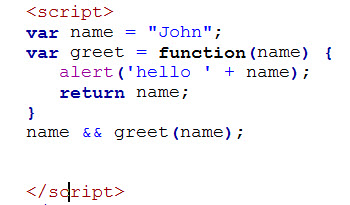 not Source Code HTML Code Submitted by IncludeHelp, on April 14, 2019 .
Logical OR ( || ) a || b: is true if either a or b is true. Logical Operators in JavaScript .
JavaScript Logical Operators JavaScript Logical Operators are used to create boolean conditions, modify a boolean expression, or combine two or more simple conditions to form a complex condition.
with the expected result that a and b get the value 5. The bitwise NOT operator ( ~) inverts the bits of its operand. Then the a is also set to 5, the return value of b = 5, aka right operand of the assignment.. As another example, the unique exponentiation operator has right-associativity, whereas other arithmetic operators have left-associativity.
()Although they are called "logical", they can be applied to values of any type, not only boolean.The result can also be of any type.
For example: NOT EQAL TO !=.
There are two important things about these operators: 1) they guarantee short-circuit evaluation, 2) they introduce a sequence point, 3) they evaluate their operands only once. It is also known as a conditional operator.
If one or both operands is false, then it returns false . This operator tries to compare values irrespective of whether they are of different types. the function similar to Inverter gate in digital electronics. JavaScript uses an exclamation point !
There are two important things about these operators: 1) they guarantee short-circuit evaluation, 2) they introduce a sequence point, 3) they evaluate their operands only once.
It is typically used with Boolean (logical) values.
operator, produces the value false if its single operand can be coerced into true; otherwise, it returns true. If the operator requires two operands, then it is a binary operator.
The AND (AND) operator returns true if all operands are `true` and 'falsy` if any operand is 'false' If used outside of boolean contexts, it will default to the right-hand operand if they are all true.
(user && user.
In this case it is the truthy or falsey value. const a = 2; // strict equal operator console.log (a === 2); // true console.log (a === '2'); // false. The logical operators are described in the following table: Operator.
There are three logical operators in JavaScript: || (OR), && (AND), !
So let's dive a little deeper into the JavaScript not logical operator and examine truthfulness in JavaScript.
The logical NOT (!) OR is written as ||. 13.5.6 Bitwise NOT Operator ( ~) 13.5.6.1 RS: Evaluation 13.13 Binary Logical Operators. Con la sintaxis expandida, esto se vuelve mucho mas prctico: (x == y) is true: Try it Conditional (Ternary) Operator. If the condition is false, expression2 is executed. Here we cover the first three, the ??
Lets revisit the previous example and change it so the if statement evaluates to true: if (!0) { //this will execute } The ! determines the truth of what a value is not: In JavaScript a logical operator performs operations based on the logical output of two operands. // True if `a` or `b` is truthy. The strict equality operator is a bit longer to write, but makes it obvious whats going on and leaves less room for errors. is not an operator, it's just the !
Non-boolean values get converted to boolean values first, then are negated.
operand1.
Logical AND Operator. What is Logical NOT Operator (!)
It is typically used with boolean (logical) values. 0, null, undefined, etc.
Logical operators work with the test conditions and return the result based on the condition's results, these can also be used to validate multiple conditions together. xor (Logical XOR operator) This operator returns true if either statement one is true or statement two is true but not both.
And === also checks for the data type while comparing.
true - if and only if all the operands are true. (NOT) &&(AND) ||(OR)! The below table describes them.
evaluates the operand, converting it to boolean and then negating it. The JavaScript NOT operator is an ! 13.13.1 RS: Evaluation But first, lets see what happens with boolean values. Logical AND operator. Truth Table of && Operator.
The !!
They are called logical, but can be applied to values of any type, their result can also be of any type. Here, we learn about the Logical AND operator and its various examples in the C programming language. Discussion
In web pages, the global object is window, so you can set and access global variables using the window.variable syntax.. Consequently, you can access global variables declared in one window or frame from another window or frame by specifying the window or frame name. 1) The Logical NOT operator (!) Operator. Will only be `false` if // both `a` and `b` are falsy. isAdmin);} The !
Then the a is also set to 5, the return value of b = 5, aka right operand of the assignment.. As another example, the unique exponentiation operator has right-associativity, whereas other arithmetic operators have left-associativity. So let's dive a little deeper into the JavaScript not logical operator and examine truthfulness in JavaScript. === evaluates to true if the operands are equal and of the same type.
returns true if the given value is false and returns false if
+ The unary plus operator converts its operand to Number type.-The unary negation operator converts its operand to Number type and then negates it.
There are three logical operators in Javascript: ! (x > y);