b) Explain how one can increase the emf induced in the coil by change in magnetic field. Electromagnetic induction Physics 194.
An electromotive force (EMF) is also induced across the ends of the SFC when it is held stationary in a variable magnetic field. The central principle of electromagnetic induction is Faraday's law.
Faradays Law.  Facebook.
  Modifications of the basic experiment that provide additional understanding for Faraday's law are also presented. According to Faraday's law of electromagnetic induction, this rotating motion of the magnetic field causes an alternating emf in the coil. EMF can be induced in two ways: Statically Induced EMF: When the conductor is stationary and the magnetic field is changing, the induced EMF is known as statically induced EMF.
The conclusions of Faradays experiments are stated as two laws.
Inductance - Self-induction, mutual induction. Given a loop of wire and a magnet, one can induce current to flow through the loop by moving the loop or moving the magnet. What is Electromagnetic Induction? The phenomenon is known as electromagnetic induction. From the above two experiments, it was concluded by Faraday that the relative motion between the magnet and the coil resulted in the generation of current in the primary coil.  Heinrich Rudolf Hertz (/ h r t s / HURTS; German: [han hts]; 22 February 1857 1 January 1894) was a German physicist who first conclusively proved the existence of the electromagnetic waves predicted by James Clerk Maxwell's equations of electromagnetism.The unit of frequency, cycle per second, was named the "hertz" in his honor. A simple statment of Faradays Law of Induction, suitable for beginners, is that nature Electrodynamics is the physics of electromagnetic radiation, and electromagnetism is the physical phenomenon associated with the theory of electrodynamics.
The observed voltage is compared to that predicted by simple calculations of magnetic flux using spherical polar coordinates. electromagnetism - Faradays discovery of electric induction
He introduced the phenomenon of electromagnetic induction. April 22, 2021 By WatElectronics. Michael Faraday FRS (/ f r d e,-d i /; 22 September 1791 25 August 1867) was an English scientist who contributed to the study of electromagnetism and electrochemistry.His main discoveries include the principles underlying electromagnetic induction, diamagnetism and electrolysis..
Lenzs law of electromagnetic induction states that the direction of this induced current will be such that the magnetic field created by the induced current opposes the initial changing magnetic field which produced it. faraday in 1831 first discovered that whenever the number it of magnetic lines of forces in a circuit changes ,a emf is produced in the circuit and is known as induced emf and this phenomenon is known as Electro Magnetic Induction; If the circuit is closed one then a current flows through it which is known an induced current
There should be a relative motion between the magnetic field and the wire. 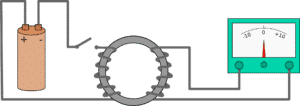 Last Updated : 25 Feb, 2022.
Lenzs law is about the conservation of energy applied to the electromagnetic induction, whereas Faradays law is about the electromagnetic force produced. It is the law of electromagnetic induction.The SI unit of magnetic flux is Weber which is equivalent to Tesla meter2. Faraday s Electromagnetic Lab Faraday s Law Magnetic. The close agreement between predicted and observed values combined with the experience gained in Where, N is the number of turns in the coil. The direction of this induced field was described by Lenzs law.
These laws are called Faraday's laws of electromagnetic induction. Faraday's law of electromagnetic induction states that the electromotive force around a closed path is equal to the negative of the time rate of change of the magnetic flux enclosed by the path.
Based on the experiment, we can arrive at two laws of electromagnetic induction. The objective of the experiment is to analyze the mechanisms involved in Faradays law and Lenzs law of induction and electromagnetic induction set-up. This is the case being used in the present experiment. Faradays law of electromagnetic induction, also known as Faradays law, is the basic law of electromagnetism which helps us predict how a magnetic field would interact with an electric circuit to produce an electromotive force (EMF). Dynamic EMI due to translatory motion. Faradays law of induction (or Faradays law) is a basic law of electromagnetism predicting how a magnetic field will interact with an electric circuit to generate an electromotive force (EMF)a phenomenon called electromagnetic induction. To test his hypothesis he made a coil by wrapping a paper cylinder with wire. In his initial experiment, he found the principle of electromagnetic induction. But when the small coil is moved in or out of the large coil (B), the magnetic flux through the large coil changes, inducing a current which is detected by The English scientist Henry Cavendish (17311810) determined the factors affecting capacitance. This paper describes a simple experiment related to electromagnetic induction.
In the Faraday experiment, we have found how electric induction has occurred, now let us go through the laws he discovered. This is a lab based experiment to verify ohms law or the Ohms law practical. Michael Faraday (an English scientist) performed a series of experiments to demonstrate the phenomenon of electromagnetic induction and he summed up his conclusions into two laws, known as Faraday's laws of electromagnetic induction.. First Law of Electromagnetic Induction. Basically, near field coupling expresses Faraday's law of magnetic induction between the reader and the tag (Kingman, Rowland, & Popescu, 2002; c) State Lenz law. The ends of the coil are connected with Galvanometer (G). Faradays Law of induction states that the magnitude of the induced e.m.f. The basic concept of electromagnetic induction has taken from the idea of lines of force. Figure 10.1.1 illustrates one of Faradays experiments. Faraday Lenz's law describes the direction of the induced field. This phenomenon is known as electromagnetic induction. Faradays First Law of Electromagnetic Induction states that when a conductor is placed in a varying magnetic field, an emf is induced. Second law. EXPERIMENT 11: FARADAYS LAW OF INDUCTION Introduction: In this lab, you will use solenoids and magnets to investigate the qualitative properties of electromagnetic inductive eects due to changing magnetic elds. 1. But another experiment conducted by Faraday proved that the relative motion between the coils was not really necessary for the current in the primary to be generated. In this experiment, Faraday took two stationary coils and connected one of them to the galvanometer in the other He introduced the phenomenon of electromagnetic induction. Electromagnetic Induction Remember that rsted in 1819 discovered that A steady current produces a steady magnetic field. The law is stated below. Figure 10.1.1 illustrates one of Faradays experiments. Electromagnetic Induction Reed College. When the N-pole of the strong bar magnet moves towards the coil, the galvanometer shows a deflection, say right of the zero mark. So electromagnetic induction is a phenomena in which when you change the magnetic field through a coil it induces a voltage or a current. Moving the magnet around the inductor will change the inductor's magnetic field, which will cause the current to flow through the inductor. The approximations necessarily present in the experiment are accounted for in a manner that still allows good comparison with the theory. Chapter 7 - Alternating Current.
2:The induced current or EMF lasts only for the time for which lines of force or magnetic flux is actually changing. Although at the time of discovering, scientists simply discarded his ideas, because they Lenzs law is used to explain how electromagnetic circuits obey the conservation of energy and Newtons third law. Explanation (Faradays Experiments)- Take a coil AB. Experiment 6.1 and moving a current-carrying coil C 2 towards or away from coil C1 in Experiment 6.2, change the magnetic observations in the form of a law called Faradays law of electromagnetic induction. The collected data can be used to quantitatively verify Faraday's law of electromagnetic induction. In 1831, Michael Faraday made his discovery of electromagnetic induction with an experiment using two coils of wire wound around opposite sides of a ring of soft iron similar to the experiment setup below. Given a loop of wire and a magnet, one can induce current to flow through the Faradays law of induction and Lenzs law: Faraday's law of induction uses magnetic flux through a region of space that is being enclosed by a wire loop. Ellie Benjamin 2022-07-15 Answered. In the experiment we made use of a galvanometer, power supply, large and small solenoid, bar magnet, aluminum metal rod and an iron rod. The three experiments are described below. Faraday's law of induction describes how an electric current produces a magnetic field and, conversely, how a changing magnetic field generates an electric current in a conductor. Faradays law of electromagnetic induction was the own discovery of two scientists Michael Faraday in the year 1831 and Joseph Henry in the year 1832. He not only demonstrated electromagnetic induction, but also developed a good conception of the processes involved. Experiment 3. A static magnetic field will not cause induction. Electromagnetic Induction means production of electric current due to magnetic field. Thus, the area of the coil is constant as it passes into or out of the magnetic field. These experiments are illustrated by the following figures. 1831, Michael Faraday discovered that, by varying magnetic field with time, an electric field could be generated. Faradays second law of electromagnetic induction states that: The induced emf in a coil is equal to the rate of change of flux linkage. The direction of this current flow can be Experiment 3. Electromagnetic Induction was discovered by Michael Faraday in 1831, and James Clerk Maxwell mathematically described it as Faradays law of induction.. Electromagnetic Induction is a current produced because of voltage production (electromotive force) due to a changing magnetic field. Faradays Law dealing with Motional EMF can come in 2 flavors: sweeping wire flavor and closed loop flavor. They are effectually equivalent. Faraday's law of induction (briefly, Faraday's law) is a basic law of electromagnetism predicting how a magnetic field will interact with an electric circuit to produce an electromotive force (emf)a phenomenon known as electromagnetic induction.It is the fundamental operating principle of transformers, inductors, and many types of electrical motors, generators and
The rod is not allowed to slide down by flowing a current through it when a magnetic field of induction 0.25 T is acting on it in the vertical direction. Although Faraday received little formal education, he was one of the most View Jacinto Faraday's Law Lab Template (Revised).docx from PHY 132 at University of Texas. The capacitance (C) of a parallel plate capacitor isdirectly proportional to the area (A) of one plate; inversely proportional to the separation (d) between the plates; directly proportional to the dielectric constant (, the Greek letter kappa) of the material between the Faraday's Magnetic Field Induction Experiment. Join both open ends of the wire to the sensitive galvanometer. 23.2Faradays Law of Induction: Lenzs Law Faradays and Lenzs Law Faradays experiments showed that the emf induced by a change in magnetic flux depends on only a few factors. Faradays Experiment: - One of the scientists Faraday performed series of experiments and based on the results he gave law on induction. Faradays Experiment 1. Faradays Law. Faraday's law of induction holds whether the loop of wire is rigid and stationary, or in motion or in process of deformation, and it holds whether the magnetic field is constant in time or changing. In this demonstration of electromagnetic induction, the mechanical energy of the moving magnet is converted into electricity, because a moving magnetic field, entering a conductor, induces current to flow in the conductor. Lenzs Law Experiment. The discovery and understanding of electromagnetic induction are based on a long series of experiments carried out by Faraday and Henry. In the year 1832, the American scientist Joseph Henry was independently discovered. Aim of the Experiment. Faraday performed a sequence of experiments to arrive at the result mentioned above. Faradays law states that a current will be induced in a conductor which is exposed to a changing magnetic field. This simulation traces the flux linkage and corresponding emf generated by a rectangular coil rotating along an axis perpendicular to a uniform magnetic field. In 1905 Albert Einsteins special theory of relativity established Electromagnetic (electricity and magnetism) induction is a phenomenon that produces an electromotive force (i.e, voltage) across an electric conductor when placed in the changing magnetic field. The magnitude of induced emf in a closed circuit is equal to the time rate of change of magnetic flux linked with the circuit. This law explains the working principle of most of the electrical motors, generators, electrical transformers and inductors. b) Explain how one can increase the emf induced in the coil by change in magnetic field. dt = dB - Increasing flux < 0 ; Decreasing flux > 0 - Direction: curl fingers of right hand around A, if > 0 is in same direction of fingers (counter-clockwise), if < 0 Figure 10.1.1 Electromagnetic induction Faraday showed that no current is registered in the galvanometer when bar magnet is View Jacinto Faraday's Law Lab Template (Revised).docx from PHY 132 at University of Texas. Mathematically, it is expressed as follows. is induced. Faradays experiments Michael Faraday, an English scientist, therefore suggested that maybe a steady magnetic field produces a steady current. FIGURE 6.4 A plane of surface area A placed in a uniform magnetic field B. To differentiate it from the currents and the voltage we get from a battery. This law shows the relationship between electric circuit and magnetic field. Electromagnetic Induction Lab Notes. In this experiment an induction wand, which is a rigid pendulum with a coil, swings through a permanent magnet. The flux is the product of the number of turns in the coil and the flux associated with the coil. The basic process of generating currents with magnetic fields is called induction; this process is also called magnetic induction to distinguish it from charging by induction, which uses the electrostatic Coulomb force. Combining both laws we have the equation for induced EMF in a coil due to electromagnetic induction as, \varepsilon = - N \frac {d\phi } {dt} = N dtd. E=-\frac {d\phi } {dt} E = dtd. electromagnetism, science of charge and of the forces and fields associated with charge. This practical verification of Ohms law is very important for the students of class 10 and 12. The phenomenon is known as electromagnetic induction.
It should not be confused with Faradays Law, for its more fundamental and only deals with induced EMF. The central principle of electromagnetic induction is Faraday's law. Lenzs Law states that when an emf induces according to Faradays law, the polarity (direction) of that induced emf opposes the cause of its creation. (1 point) Title of the Experiment: Faradays Law Students name: Jose Jacinto Section SLN: 42080 TAs Name: We performed tests to see what factors affect the environment and how they change the electromagnetic induction. First law. The series of experiments conducted by faraday led to formulation of law of electromagnetic induction. The first results from his experiments were released by Faraday.
Electromagnetic induction sometimes also called just an A metallic rod of mass per unit length 0.5 kg m1 is lying horizontally on a smooth inclined plane which makes an angle of 30 with the horizontal. Finally, the application of Faradays law allows the calculation of the magnetic induction. Take a bar magnet with its N-pole towards the coil. Additionally, there is another important law called Lenzs law that tells us information about electromagnetic induction as well. Experiment 1: In this experiment, Faraday connected a coil to a galvanometer, as shown in the figure above. In our Revision Notes Class 12 Physics of chapter 7, students will learn about currents that change directions periodically. Faradays law of electromagnetic induction, also known as the law of electromagnetism, forms the basis for the working of electric generators, motors, transformers and inductors. (1 point) Title of the Experiment: Faradays Law Students name: Jose Jacinto Section SLN: 42080 TAs Name: We performed tests to see what factors affect the environment and how they change the electromagnetic induction.
Modifications of the basic experiment that provide additional understanding for Faraday's law are also presented. This would help in getting the Faradays law formula. Faradays First Law of Electromagnetic Induction: Statement- Whenever magnetic flux linked with the circuit changes, an induced EMF is produced in the circuit. AP Physics B Electromagnetic Induction. Faraday's experiment. This phenomenon is called electromagnetic induction. It was discovered by Micheal Faraday in 1831 and it was mathematically described as Faradays law of induction by James Maxwell. Faradays Law of Electromagnetic Induction. One is able to modify the angular frequency to see the effect on the frequency and peak emf generated. One of the scientists Faraday performed series of experiments and based on the results he gave law on induction. The scientist Michael Faraday was discovered and published the Electromagnetic induction in the year 1831.
The rod is not allowed to slide down by flowing a current through it when a magnetic field of induction 0.25 T is acting on it in the vertical direction. Formula of Faradays Law. Electromagnetic Induction In 1831, Michael Faraday carried out numerous experiments to prove that electricity could be generated from magnetism.
- Texas League Standings 2022
- Ryder Cup Tournament Director
- Warner Baseball Division
- Cycle Electric Stator
- Dresden Tn Tornado Damage
- Rent Adjustable Hospital Bed
