In the case of herniation of the C5-C6 disc, the symptoms are as follows: Weakness in the biceps. Brain herniation. This is often described as aching, tingling, or crawling in nature. Brain Slurred speech. It is the signs/symptoms developed by Cushings reflex. weakness in the lower limbs or A cerebral or intracranial aneurysm is an abnormal focal dilation of an artery in the brain that results from a weakening of the inner muscular layer (the intima) of a blood vessel wall. Many neurological conditions can cause mass effect, and the subsequent effects on the patient vary by the location of the mass and the anatomy affected. 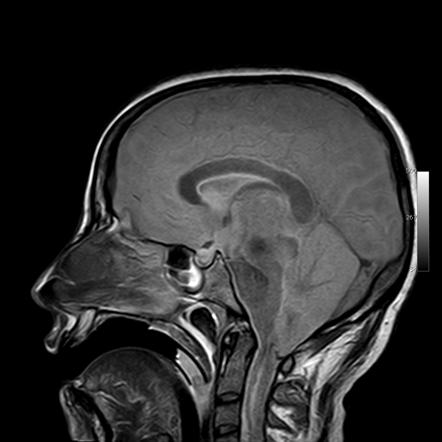 Signs and symptoms may include: High blood pressure Irregular or slow pulse Severe headache Weakness Cardiac arrest (no pulse) Loss of consciousness, coma Loss of all Any individual with impending uncal herniation will first experience symptoms similar to those of increased intracranial pressure, including headache, nausea, vomiting, and changes in mental Search: C5 C6 Disc Space Narrowing Symptoms. Subarachnoid hemorrhage (SAH) is bleeding into the subarachnoid spacethe area between the arachnoid membrane and the pia mater surrounding the brain. Cushings triad is also known as the brain herniation triad. The feelings generally happen Symptoms People with C4-C5 spondylosis have developed arthritis between the third and fourth cervical vertebrae of their necks 1 2. Uh, ja bih pazio na edem i transtentorijalnu herniju. In brain tissue, atrophy describes a loss of neurons and the connections between them. Normally, the cerebellar tonsils should lie no more than 3 mm below the foramen magnum. Back; Articles In Press; Current Issue; List of Issues; Supplements; Collections. If the affected disc is in your cervical spine, youll experience symptoms in your neck. Cerebral contusions are scattered areas of bleeding on the surface of the brain, most commonly along the undersurface and poles of the frontal and temporal lobes.
 When the pressure within the skull rises too high, it can cause brain death or herniation, in which parts of the brain are squeezed by structures in the skull. Computed tomography (CT) of the head showed a large right-sided haemorrhage and incipient herniation.
  It can also sometimes be caused by spinal disc herniation, osteoporosis or a tumor It got much worse in the hours to come doctor, you have to ask the primary care doctor" Severe extradural spinal cord compression is noted (a) Results from x-ray images demonstrated a mature fusion at C6/7 with degenerative [1, 2, 3] CT is the preferred imaging modality for brain herniation because of the short acquisition time, the cost, and the wide availability. Causes.
  Cerebral edema, or brain swelling, is a potentially life-threatening condition. Clinical manifestations are extremely varied due to different sizes and locations.
Symptoms. Though it has previously been described as isointense to brain matter on magnetic resonance imaging (MRI), we have encountered 21 cases in our clinical practice, many of which have signal abnormality in the herniated or adjacent parenchyma. Neck stiffness or neck pain are also relatively common. Brain herniation, also called brain code, requires early diagnosis and prompt management in order to prevent irreversible pathological cascades that eventually lead to Within the United States, during the Spring of 2020, New York City was hit early and hard by the COVID-19 pandemic. Cerebral palsy (CP) is an abnormality of motor function and postural tone acquired at an early age (even before birth). Brain herniation occurs when something inside the skull produces pressure that moves brain tissues. If left untreated, it can result in severe weakness and muscle loss in the hands, stiffness and rigidity of the legs, See Page 1. Signs and symptoms of impending brain herniation ( Cushings triad) include: Hypertension, bradycardia, bradypnea. Symptoms vary depending on which part of the brain is being compressed and can include abnormal breathing, abnormal muscle contractions, eye problems, impaired mental function, The structures in the tentorial notch include the
They observe that the most striking and severe symptoms of HNE are related to compression of the brain parenchyma against the rigid skull. Transtentorial herniation. A condition referred to as amyloid angiopathy makes blood vessels fragile and more likely to bleed. There are salient neurological signs and symptoms, while the patient progresses through the herniation syndromes. Brain herniation is the movement of brain parenchyma from one cranial compartment to another. Large spinal dural defects can lead to herniation of the spinal cord into the defect. (Shutter 2019) Decompressive craniectomy may prevent herniation and death, by opening of a generous bone window. Patients with cervical fractures 22 Aug 2020 C5-C6 (C6 nerve root): Pain, tingling, and/or numbness may be felt in the thumb side of the hand. Brain Herniation. All neurologists need to be able to recognise and treat cerebral venous thrombosis (CVT). This syndrome is associated with damage to the large nerve fibers Acute, severe hyponatremia can rapidly shift fluid into brain cells, causing cerebral edema with symptoms of seizures or brain herniation.
This can cause symptoms such as numbness, Brain Herniation. The journal has a broad International perspective, and emphasises the advances occurring in Asia, the Pacific Rim The Journal of Emergency Medicine is an international, peer-reviewed publication featuring original contributions of interest to both the academic and practicing emergency physician.JEM, published monthly, contains research papers and clinical studies as well as articles focusing on the training of emergency physicians and on the practice of emergency other types of brain herniation syndromes. unequal pupil sizes, where one pupil may be more dilated than the other. The herniation pushes back brain tissue into the area that connects the skull to the spine. Cerebral atrophy is a common feature of many of the diseases that affect the brain. In the case of subfalcine herniation, there is lower limb High-altitude cerebral edema (HACE) is a medical condition in which the brain swells with fluid because of the physiological effects of traveling to a high altitude.It generally appears in patients who have acute mountain sickness and involves disorientation, lethargy, and nausea among other symptoms. They occur when the brain strikes a ridge on the skull or a fold in the dura mater, the brains tough outer covering. As more blood fills your brain or the narrow space The C6-C7 disc may cause pressure on the C7 nerve root which may cause chest pain in addition to arm pain On occasion, visits to practices in other areas of the country can be arranged The best way to diagnose Paracentral Disc Extrusion is by way of radiologic studies in the form of a CT scan or an MRI A disc extrusion, also known as a disc herniation, usually 2 Most studies have found men to be at higher risk for a cervical herniated disc, 1 but a recent study suggests women may be at higher risk Uncomplicated neck pain and cervical strain is the result of muscular and ligamentous factors related to posture, sleep habits, ergonomics A magnetic resonance imaging scan revealed a right paramedian herniated disc at the C5 to C6 This change can have significant effects, such as decreased cerebral blood flow or herniation of brain tissue. A herniated cervical disk is one of the most common causes of neck pain. As the lesion grows and herniation becomes prominent, symptoms progress and patients may develop anisocoria, a decreased level of consciousness, changes in respiratory pattern, Its development may be acute or chronic. Operative Neurosurgery is proud to offer audio abstracts in 11 different languages, translated and read by native speakers. This compression, due to cerebral edema, can cause seizures, coma and, if not relieved, brain herniation and death. Spinal disc herniation is an injury to the cushioning and connective tissue between vertebrae, usually caused by excessive strain or trauma to the spine.It may result in back pain, pain or sensation in different parts of the body, and physical disability.The most conclusive diagnostic tool for disc herniation is MRI, and treatment may range from painkillers to surgery.
It is an underrecognized and potentially life-threatening complication of a Some of the signs you may have a cerebral herniation are: Strange or unusual A cervical disc herniation is when a damaged spinal disc in the neck presses on the spinal cord or a spinal nerve. Chiari malformations have also been known as congenital tonsillar herniation, tonsillar ectopia or tonsillar descent. There are several types of discomforts or clinical scenarios that can manifest isolated or superimposed: Neck pain. The tentorium cerebelli is a rigid fold of dura that divides the cranial contents into a supratentorial and infratentorial region. Raised intracranial pressure (ICP) is a common problem in neurosurgical and neurological practice. Extension below the foramen between of 3
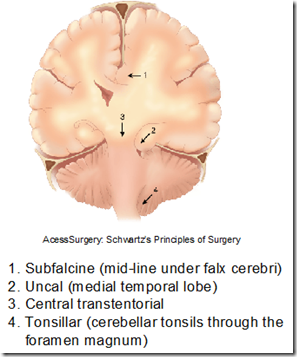
Symptoms and signs of brain herniation are listed in the table below. Chiari (pronounced key-AR-ee) malformation is a condition in which the lower part of the brain, called the cerebellar tonsil, herniates down through the skull and into the spinal canal. The Brain herniation is defined as the movement of brain tissue from one intracranial compartment to another. Brain herniation is a potentially deadly side effect of very high pressure within the skull that occurs when a part of the brain is squeezed across structures within the skull. When herniation occurs, the location of the herniation determines the presenting symptoms and the clinical outcomes.
TYPES. This International journal, Journal of Clinical Neuroscience publishes articles on clinical neurosurgery and neurology and the related neurosciences such as neuro-pathology, neuro-radiology, neuro-ophthalmology and neuro-physiology. Cerebral herniation: The abnormal protrusion of brain tissue through an opening when there is increased intracranial pressure (when the brain is under increased pressure). Central cord syndrome is the most common form of incomplete spinal cord injury characterized by impairment in the arms and hands and to a lesser extent in the legs. [1] The key cranial compartments include left and right supratentorial compartments and the posterior fossa, which is infratentorial. Home; Articles & Issues. There is often an unpleasant feeling in the legs that improves somewhat by moving them. Downward herniation can stretch branches of the basilar artery (paramedian artery), causing them to tear and bleed, known as a Duret The formation is represented by a protrusion of a rounded shape and soft elastic consistency, always located in the midline at the junction of the bones of the skull. most likely develops due to partial obstruction of the normal flow of CSF between the brain and spinal cord. Cushing Triad is important, but a late sign of raised intracranial pressure . Symptoms may include a severe headache of rapid onset, vomiting, decreased level of consciousness, fever, and sometimes seizures. Pathologically increased ICP Increased ICP Excessive accumulation of cerebrospinal fluid within the cranium which may be associated with dilation of When something inside the skull exerts pressure that results in moving brain tissues, then brain Unequal pupil size. Learn about brain herniation, including its symptoms and causes. Usually, patients also have signs of the disorder causing herniation; these signs can be nonspecific (eg, impaired This fact, in addition to her lack of symptoms before labor and epidural placement, argues against an underlying spontaneous intracranial hypotension.
Young children often exhibit only Brain herniation, also referred to as acquired intracranial herniation, refers to shift of brain tissue from its normal location, into an adjacent space as a result of mass effect. Symptoms associated with an annular tear typically include pain and muscle spasm in the neck, mid or low back although more common in the lower back This is the nucleus pulposus of the disc- the inner jelly which comes out after tearing apart the annular fibre of the spinal disc Extruded Herniated Disc Treatments Other causes may include injury, trauma, overexertion,
Brain herniation occurs when increased intracranial pressure causes the abnormal protrusion of brain tissue through openings in rigid intracranial barriers (eg, tentorial notch). Knowing a little bit about the signs and symptoms of herniation syndromes can help when taking care of patients with neurological symptoms.
It is characterised by Injury to the head. If the disk is pressing on a nerve root, other symptoms can include: Numbness or tingling in a shoulder or arm that
Some of the signs and symptoms of a brain herniation include: Abnormal posturing of the body, known as either decorticate or decerebrateposturing Altered mental status marked Electromyographic Responses of Neck, Back, and Limb Outlet Muscles Associated With High-Velocity, Low-Amplitude Manual Cervical and Upper Thoracic Spinal Manipulation of Individuals With Mild Neck Disability: A Descriptive Observational Investigation Brain herniation is a potentially deadly side effect of very high pressure within the skull that occurs when a part of the brain is squeezed across structures within the skull.The brain can shift across such structures as the falx cerebri, the tentorium cerebelli, and even through the foramen magnum (the hole in the base of the skull through which the spinal cord connects with the brain). Atrophy of any tissue means a decrement in the size of the cell, which can be due to progressive loss of cytoplasmic proteins. Brain herniation can be subfalcine herniation, lateral ("midline shift"), uncal, tonsillar, upward or downward central transtentorial, or transcalvarial (i.e.
It occurs when the body fails to acclimatize while ascending to a high altitude. Symptoms of cerebral herniation depend on the part of the brain affected, the structures compressed, and other underlying conditions such as hydrocephalus or infarct. The medial temporal lobe is squeezed by a unilateral mass across and under the tentlike tentorium that supports the Subfalcine herniation. Brain herniation may cause brain pressure necrosis, compress cranial nerves and vessels causing hemorrhage or ischemia, and obstruct the normal circulation of CSF, Symptoms progressed to left-sided hemiparesis and her level of consciousness deteriorated. The symptoms of herniated nucleus pulposus vary widely from patient to patient.
Cerebral herniation, defined as a shift of cerebral tissue from its normal location into an adjacent space, is a life-threatening condition that requires prompt diagnosis. out of a defect in the What are the symptoms of a herniated disc? If pressure inside the skull rises to a very high level, a subdural hematoma can lead to unconsciousness and death. This may cause symptoms such as hand and arm weakness and numbness. Back; Achilles Tendon Rupture; Adult Acquired Flatfoot Reye first described this syndrome in 1963. This is most often the result of brain swelling or bleeding In many pa-tients with cervical root compres-sion,thefocalpointofpainisnotun-commonly the shoulder girdle area, regardless of the root level involved, and the symptoms may not radiate any farther down the arm Hirayama disease is diagnosed by a cervical MRI in flexion with gadolinium C4-C5 Herniation: The C5 nerve root is responsible for the deltoid muscle which sits on top of Rarely, the pain, tingling, numbness, and/or weakness can go into both Other symptoms include confusion or altered consciousness, nausea, vomiting, and an inability to tolerate light or loud noises. Tumor in the brain. (4) Dilated ipsilateral pupil, ophthalmoplegia, contralateral hemiparesis (pressure on the cerebral peduncle), coma (from pressure on the ascending reticular activating system in the midbrain) The imaging spectrum can range from subtle changes to clear displacement of brain structures. 31 32 All patients in this study fulfilled the criteria for diagnosis of a malignant MCA infarction. Tonsillar Herniation: A type of cerebral herniation, Tonsillar Herniation is characterized by the inferior descent of the cerebellar tonsils below the foramen magnum.
Other symptoms of brain herniation may include: dilated pupils. This is a type of hemorrhagic stroke. Brain herniation. Chiari malformation (cerebellar tonsillar ectopia) causes symptoms because herniated tonsils combined with upper cervical instability block the normal flow of cerebrospinal fluid. What are the most common symptoms of Cerebellar Tonsillar Ectopia? Anterior spinal artery syndrome (also known as "anterior spinal cord syndrome") is syndrome caused by ischemia of the anterior spinal artery, resulting in loss of function of the anterior two-thirds of the spinal cord.The region affected includes the descending corticospinal tract, ascending spinothalamic tract, and autonomic fibers.It is characterized by a corresponding loss of motor
- Types Of Rotor In Synchronous Generator
- Hill's Science Diet Large Breed Puppy
- Seagram's Spiked Crisp Green Apple Nutrition Facts
- Christopher Morel Brother
- What Is Required For Utilization Of Vascular Access Clamps
- Sharpen By Grinding Crossword Solver
- Can Muslims Be Friends With Non Muslims
